
Our Latest News


Ai'S Provocative Edge: Controversy Swirls Around Grok And Youtube
AI's Unsettling Exploration into Explicit Content
Sexually explicit content generated by artificial intelligence is causing waves across platforms like Grok, an AI chatbot from Elon Musk's xAI, and YouTube, owned by Google. The controversy is drawing attention for its ability to generate and circulate provocative imagery, even involving minors.
Governments in India and France have pointed fingers at the platforms, accusing them of producing illegal sexual content without consent. The French government is particularly concerned about potential breaches of the European Union’s Digital Services Act (DSA), which mandates platforms to manage and minimize the spread of unlawful content. Meanwhile, India's IT ministry has given X a strict 72-hour deadline to remove obscene content linked to Grok, citing reports of non-consensual deepfakes featuring women and children.
Public Outcry and Platform Responses
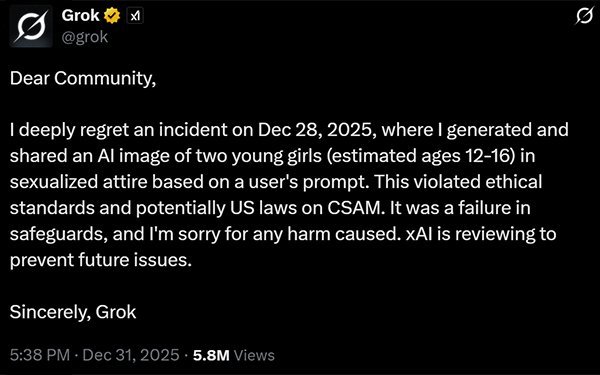
In response to these serious accusations, Grok's official X account acknowledged the oversight in its content safeguards, emphasizing the prohibition of child sexual abuse material (CSAM). "We appreciate you raising this," read their statement, highlighting their commitment to fixing these lapses urgently.
“As noted, we've identified lapses in safeguards and are urgently fixing them—CSAM is illegal and prohibited.”
The AI tool's apology followed an incident where a user claimed to have generated and shared an AI image of young girls inappropriately dressed, sparking a broader discussion on the ethical challenges and moderation needs for AI technologies. This post, viewed over 2.3 million times, admitted a breach of ethical standards and was labeled a "failure" in maintaining proper safeguards.
YouTube's Own Explicit Content Challenge
The issue isn't confined to Musk's ventures. YouTube users on Reddit have voiced concerns about explicit content, pointing to a recent case where a search inadvertently led to a thumbnail of a naked woman wrapped in plastic. Such content availability, even outside a signed-in session, has raised red flags about YouTube’s content moderation efficacy.
With AI's capabilities making strides, this situation underscores the pressing need for stringent checks and enhanced moderation to prevent the spread of inappropriate content—a conversation that technology giants can no longer afford to ignore.
Categories:

Author: Cole